


In a bid to keep up with the ever-evolving digital landscape, and propagate faith beliefs, a small Lutheran Protestant church situated in the South-Eastern state of Bavaria, Germany, in the city of Fürth, has embraced recent technology trends in a spooky phenomenon that’s sure to blow your mind! Sitting through a well-organized half-hour Sunday church service with virtually no human interaction other than with your fellows seated in the pews, you’d be pardoned for mistaking this congregation for some sort of extension of a Silicon Valley tech experiment.
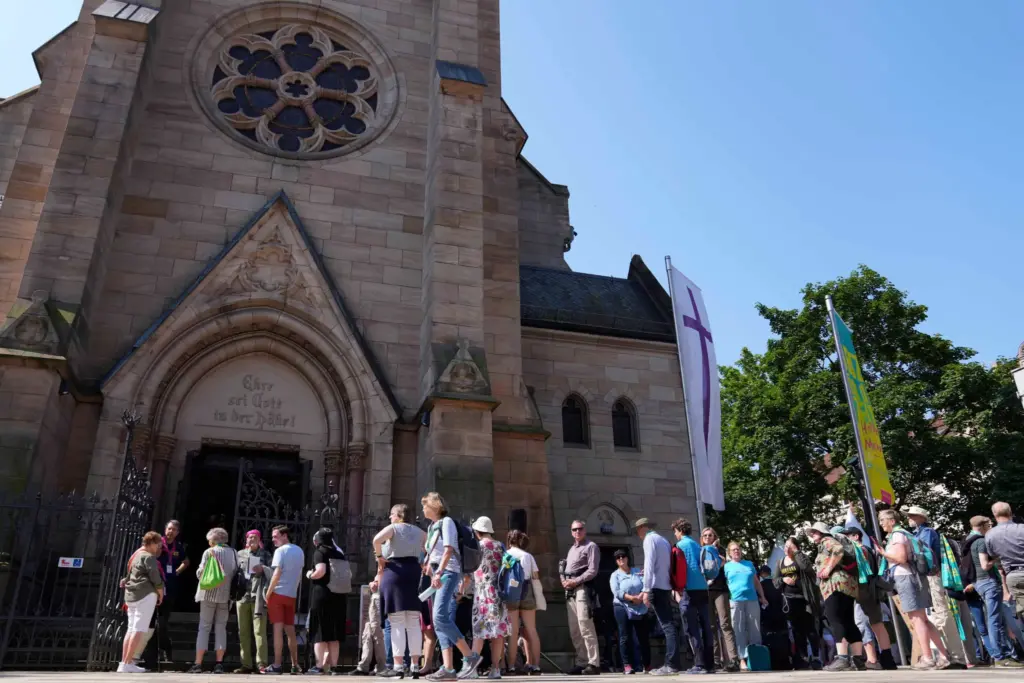
The clergy at this sanctuary have extricated themselves from shepherding the flock and have preferred to delegate that responsibility to robots. The bots not only lead the congregation in what’s supposed to be praise and worship, but also write sermons and preach the same—proudly brought to you by advanced machine learning! All that’s required is powering up the computer, punching in a few parameters and, in a flash, an avatar appears on the overhead screen to deliver the day’s sermon with the precision of a Swiss watch. There’s even the occasional roar of applause from the crowd when the bot drives the point home excellently.
If you thought that’s intriguing enough, the St. Peter’s Chapel in Lucerne, Switzerland, would make what you’ve just read feel like the stuff of Sunday school playtime. These ones are so advanced, they’ve got a bizarre creation called Deus in Machina (Jesus in a Machine)—basically, Jesus confined to a computer chip! When you waltz into the confession booth at the chapel, the character on the other side of the veil is not your regular priest, but, rather, an apparent hologram of the LORD—fondly known as AI Jesus. He’s on standby to listen, answer all your questions and offer advice on pretty much any subject, obviously based on sampled data and what he’s been trained!
Whereas AI Jesus is multilingual, which makes for fluid interactions especially since the crowds are culturally diversified, there’s one teeny-tiny problem: AI Jesus has got terms and conditions that you must agree to before indulging him! Once you enter the booth, he not only warns you NOT to disclose any personal information under any circumstance, but also tells you to use his service at your own risk! He’s clearly not taking chances with you humans, lest he gets dragged into nasty legal battles for unintentionally leaking private data!
The evolution of modern Artificial Intelligence (AI) has been so brisk that, in such a short period since its advent, nearly every sphere of life has been affected by the advancement in this semi-autonomous technology. The exponential rise of NVIDIA—the world’s largest maker of advanced computer chips—to the helm, having catapulted above Apple in valuation only a year ago, is a clear-cut testament to the AI boom. The problem is that for the first time in the history of mankind, we’re now also dealing with a creation of man that’s quickly becoming more intelligent than us.
There’s no denying that AI is fast, efficient, mostly costs less than a dinner date with your granny, and certainly makes the execution of tasks easier. However, what feels like juggling raw eggs is that temptation to hand AI control over every single human process; including, and especially, matters to do with faith and spirituality! The gravity of choosing to align with either machine or Spirit when dealing with Deity cannot be overstated.
AI generally gives the illusion of competence as it’s heavily reliant on available data for its training and, therefore, makes decisions merely based on patterns and trends. As such, if the dataset it’s been fed with has errors or is corrupted, it will most definitely return fake and inaccurate results. With no ounce of Divine inspiration, you can only imagine the sheer volume of heretic preachings and how much flawed advice AI Jesus churns out on a weekly basis! I’m really struggling to think of anything more devilish than that!
In the aspect of reverence, worship music cannot be created extemporaneously—which’s literally the exact thing that AI bots do! There’s a lot more to this artistry than speedily putting together a bunch of beautiful computer-generated words, melodies and sounds. Worship music that inspires the exaltation and adoration of a supernatural God, and causes the dissemination of His awesome Power to the listeners, must have the Spirit of God to back that lyrical content! That, right there, is the distinguishing element that no computer chip could possibly pull off! At best, AI will create a lifeless ‘make-feel-good’ poem and, worst case—which’s extremely frightening—is that it sets a platform for ungodly spirits, otherwise known as demons, to infiltrate and occupy that void. Jesus said, “It is the Spirit who gives life; the flesh profits nothing. The words that I speak to you are spirit and are life.”—John 6:63
In principle, spiritually-inclined songwriting demands the input of every expression of one’s being: your soul (emotions, temperament), your heart (spirit, divinity), your mind (thoughts, imagination), and your strength (physical effort). “Encourage each other with psalms, hymns, and spiritual songs. Sing and make music in your hearts to the LORD.”—Ephesians 5:19.
There’s no cutting corners in this trade. But then, again, that’s pretty much the essence of sacrifice! David, the great psalmist from whom many anointed worshipers and songwriters of our day, and those from millennia past, have drawn inspiration, said he wouldn’t offer to the LORD anything that hasn’t cost him.[2 Samuel 24:24]

So, I guess the ultimate question goes out to you who’s considering, or has already orchestrated a full-blown rollout of AI to the congregation of the saints:
Unless you’re simply an agent of the devil, why would you have the product of a soulless piece of machine take God’s people through what’s essentially a mechanical, auraless, characterless, impotent praise and worship session that can literally be prepared quicker than a snack of Chinese noodles? Wouldn’t you rather let the congregation be led by a team of Spirit-filled humans to a special place at the Throne of God? And what shall happen when the AI bubble eventually bursts? Cos, as sure as night follows day, it must:
“These words “once more” indicate the removing of what can be shaken—that, is, created things—so that what cannot be shaken may remain. Therefore, since we’re receiving a Kingdom that cannot be shaken, let us be thankful, and so worship God acceptably with reverence and awe, for our God is a consuming fire.”—Hebrews 12:27-29
When the shaking happens, won’t the worship ministry that’s founded on AI crumble too? Why are believers so eager to flirt with the idea of granting a machine autonomy over their interactions with the LORD? Technology is without a doubt beneficial to humanity on many levels, but does the Body of Christ really have any standards left to maintain? If yes, at what point does the Church draw the line and say “NO” to this invasion by AI?
Related Story: The Uncanny Perspective On The Collapse Of Silicon Valley
Join the conversation on X:

Em, you’ve got to understand that not every congregation that meets in a building called Church is actually a Church of Christ. You shall know them by their fruit. His sheep know His voice!!
You’ll be absolutely shocked to discover that sometimes it’s beyond the sheep’s control! I’ll leave it at that!
Very strange and interesting times!! Very insightful piece!
Thanks Ed. This thing’s taking root faster than most Christians think! Crazy stuff!
‘AI GONE WRONG’ is one of the many related news headlines we are waiting for because those words came from God’s Mouthpiece and surely can’t fall to the ground.
There must be hidden mysteries behind this prophecy.
Thank you for this great insight Em.
Thanks for reading! Yeh, all I can think of is “AI gone wrong!”. Yet for some weird reason, there are people that actually know this but still want to construct ministries on that shaky foundation! Strange!